Buying art · Renting
How to hang art when you're not allowed to drill.
Adhesive strips work, up to a point, and the point is lower than most people assume. Here are the actual numbers, the four mistakes that cause every failure, and what to do when the frame is simply too heavy.
Sourced. The adhesive weight limits below come from Command's own published product weight limits, read on 3 September 2026 and linked. Everything else on this page is convention or arithmetic.
Weigh the frame first
Everything else on this page depends on one number, and almost nobody has it. Put the framed print on the kitchen scales. Not the print — the whole thing, glass and all.
People guess badly here, and always low. The glazing is most of the weight, so the difference between an A3 with acrylic and an A3 with real glass can be more than double, and the frame that came free with the print is heavier than it looks. Thirty seconds on the scales removes the guesswork from the rest of the decision.
What adhesive strips actually hold
These are Command's own published figures, per set of strips:
| Size | Stated limit | Which is about |
|---|---|---|
| Small | 1 lb | 0.45 kg |
| Narrow | 3 lb | 1.4 kg |
| Medium | 3 lb | 1.4 kg |
| Large | 4 lb | 1.8 kg |
Source: Command product weight limits, read 3 September 2026. That is the United States site and the figures are in pounds; Australian packs are marked in kilograms and may differ. Read your own pack. Capacity increases when you use more sets along the frame, within the guidance printed on the packaging.
Put those numbers against a real frame and the picture gets clearer. A glazed A3 is commonly in the region of one to two kilograms and an A2 rather more, which means a single set of large strips is already marginal for an A3 and nowhere near enough for a glazed A2. That is the gap between what people expect and what the packet says.
The four things that make them fail
- The wall was not clean. Not "looks clean" — wiped with isopropyl alcohol and left to dry. Not a household spray, which leaves a film precisely where you need none, and not a baby wipe. This single step is behind most failures.
- The surface was never suitable. Adhesive needs a smooth, sealed, fully-cured surface. Textured or heavily-rolled paint, brick, unsealed timber, wallpaper and freshly painted walls are all unreliable — new paint keeps curing for weeks and the strip takes the paint off with it.
- It was hung immediately. The instructions say press firmly for around thirty seconds, then leave the strips on the wall for an hour before putting the frame on. That hour is not padding; it is the adhesive bonding.
- It was hung on the limit. A frame at 90 per cent of the stated capacity is not a frame that fails at 100 per cent. Warm rooms, humidity and a knock in passing all reduce the real margin. Halving the stated figure is a sensible working rule, and it is what the difference between "held for a year" and "came down at 2am" usually comes down to.
When the frame is too heavy for strips
There are three good answers and they all avoid the wall entirely.
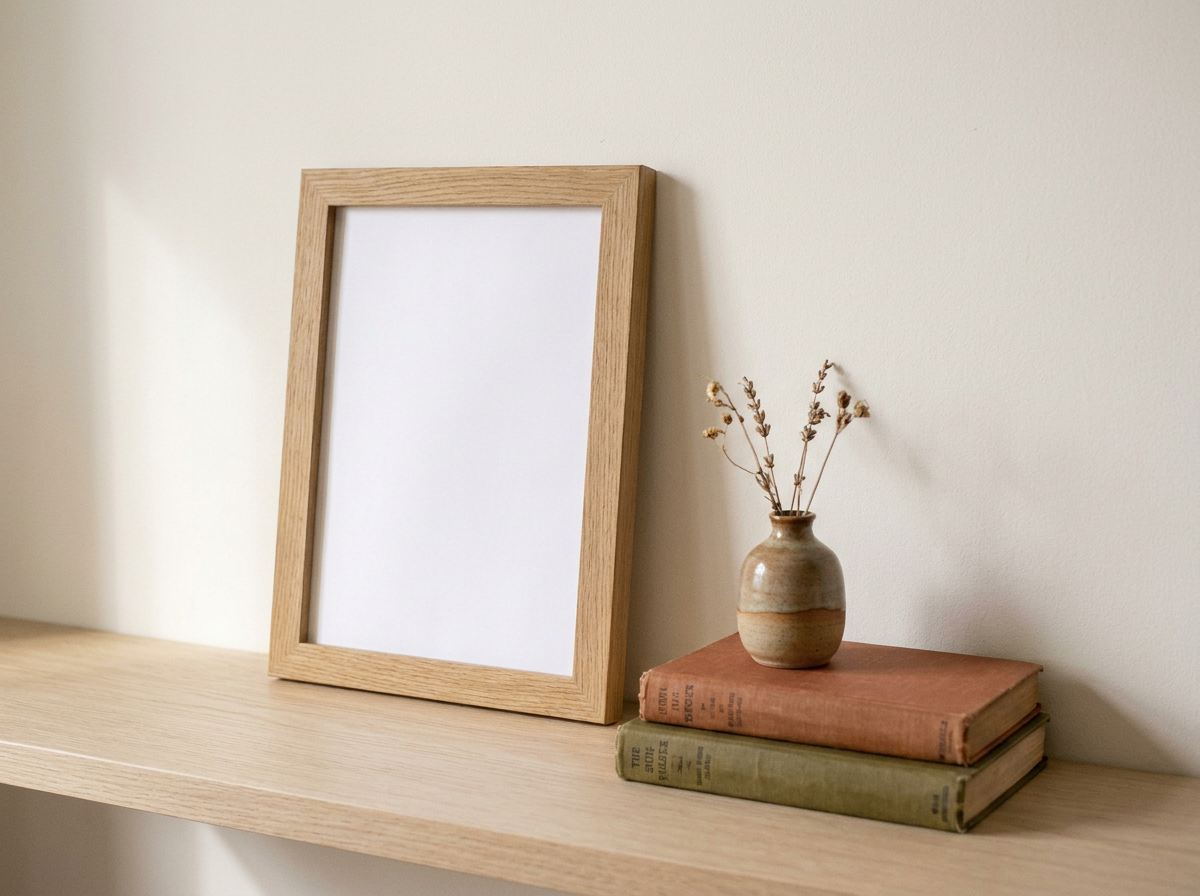
- Lean it. A print resting on a shelf, a mantel, a sideboard or a picture ledge is a deliberate look, not a compromise, and it lets you change the arrangement in seconds. A narrow ledge is the single best purchase a renter can make for art.
- Use what is already there. Most rentals have picture hooks, a picture rail, or existing holes left by the last tenant. Existing holes are free and nobody can object to them.
- Drop the glass. An unframed print on a magnetic timber hanger, or a frame with acrylic glazing instead of glass, can weigh a third of the same piece framed conventionally — which lands it back inside what strips will hold. This is the answer most people miss.
Taking them off without taking the paint
The removal tab is the whole design and it only works if you use it properly: pull it straight down, slowly, parallel to and flat against the wall. Do not pull outwards. The adhesive is engineered to stretch and release; pulled away from the wall it behaves like any other tape and takes the paint surface with it.
If the tab has disappeared behind the strip, warm the area with a hairdryer for a minute and work dental floss behind the strip rather than levering at it.
Where not to do this at all
Above a bed, above a cot, or above where a child sits. Not because adhesive is worse than a nail, but because the consequence of a failure is different, and adhesive fails without warning while a nail generally does not. That wall wants a fixing into something solid or nothing at all — the nursery page covers this properly.
Choose something worth the trouble
Since a rental limits what you can hang, it is worth hanging something that suits the room you are actually in rather than the one you would like. Sizes are on the sizing page; if you would rather not put anything on the walls at all, the leaning arrangement in the layouts guide is the one to read.
Now find the colours
Photograph the room and the matcher reads the palette straight out of it — then shows you prints in those colours, and what they look like on paper rather than on a screen.