Buying art · Hallways
Art in a hallway, where you're standing a metre away.
Everything written about hanging art assumes you are looking at it from across a room. In a hallway you are looking at it from about a metre, at an angle, while walking. That single fact changes what belongs there.
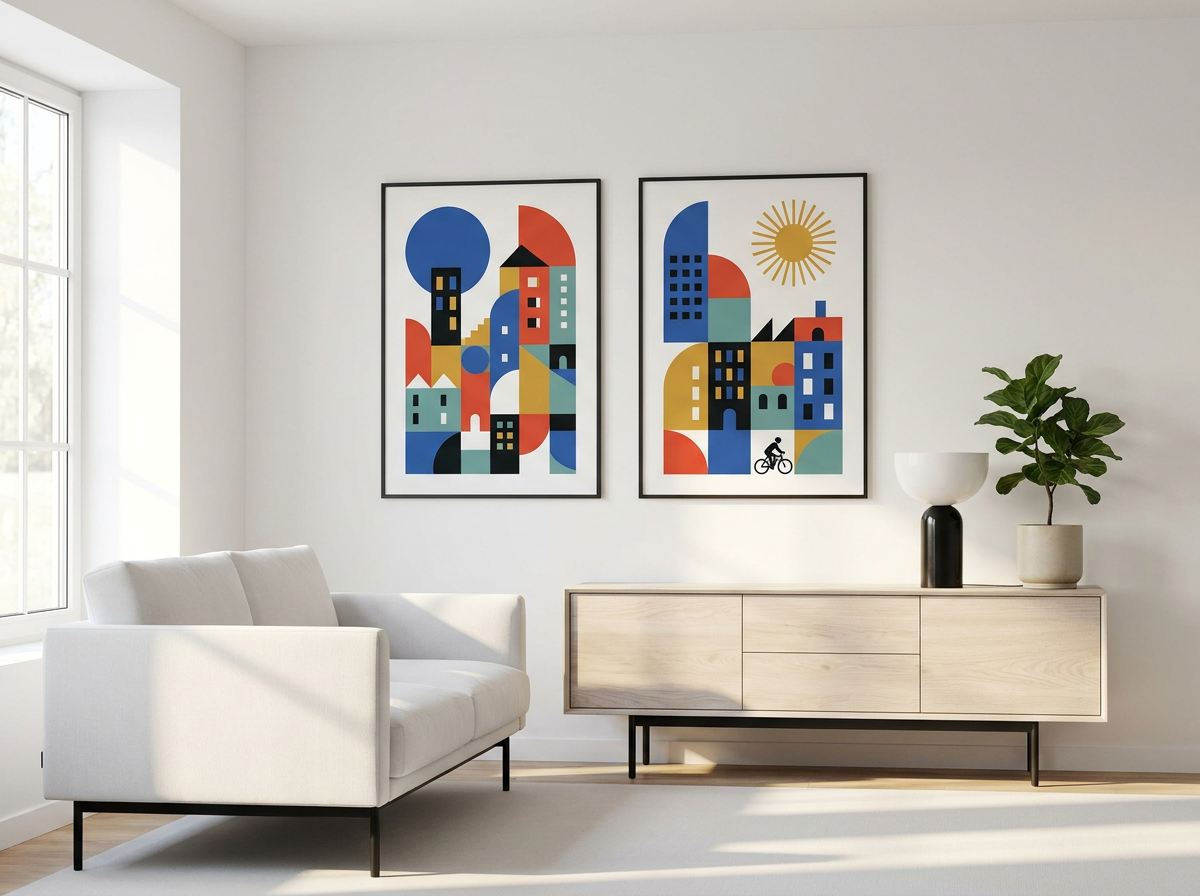
Conventions, not rules. The proportions here are what galleries and interior designers have settled on because they work in most rooms. They are a starting point, not a law.
Viewing distance is the whole thing
In a living room you sit three metres from the wall. Detail disappears at that range, which is why bold flat shapes work there and fine linework is wasted.
A hallway is typically 900 mm to 1.2 m wide. You will never stand further from that wall than about a metre, which inverts the rule completely:
- Detail is the point. Fine line work, botanical studies, etchings, small typography, anything with something to find in it. This is the one wall in the house where a delicate piece is genuinely rewarded, because it is the only wall people look at closely.
- Big statement pieces fail. A metre away you cannot see an A1 at all — you see a corner of it. The gesture is lost and the wall feels crowded.
- Small is not timid here. A4 and A3 are the right sizes in a corridor, and they are the wrong sizes above a sofa. Same house, opposite answers.
You are looking at it edge-on
The other consequence of a narrow space: you almost never see a hallway picture square-on. You see it at a sharp angle as you walk past. That matters in two ways.
- Glass becomes a mirror. At an oblique angle, glazing reflects the ceiling light straight into your eye and the artwork disappears behind it. Matte paper, unglazed or matte-glazed, is the practical choice in a corridor.
- Deep frames catch shoulders. A chunky moulding in a 900 mm hallway gets knocked, and gets knocked repeatedly. Flat, shallow profiles survive; box frames do not.
Hallways are the darkest place in the house
They usually have no window and one light. Two things follow. Subtle, low-contrast work disappears in a dim corridor — a soft grey-on-cream piece that looks refined in daylight reads as a blank sheet at night. And warm bulbs shift everything yellow, so cool blues and greys go muddy while warm palettes hold up.
If a hallway piece has to earn its place in artificial light, give it clear tonal contrast: something genuinely dark against something genuinely light. That reads at any brightness.
A sequence, because you walk past it
A hallway is the one place you experience artwork in time rather than all at once. That makes a series work better than a single piece — three or five related images at even spacing, revealed one at a time as you go. It gives a corridor a reason to be long.
The practical setting-out: keep every centre on the same line, 145 cm from the floor, and keep the gaps identical. In a narrow space any inconsistency is obvious because you pass within arm's reach of it. Gaps of 7–10 cm suit A4 and A3 frames. The planner will give you the exact positions.
Where not to put it
- Behind a door's swing. Obvious, routinely forgotten, and the handle wins every time. Open every door fully before you mark the wall.
- Directly opposite a bright window at the end of the hall. You will be looking at the artwork into the light, and you will see the glare rather than the piece.
- In the last metre before a doorway. Too close to be seen, and directly in the path of anyone carrying something through.
If it's a staircase rather than a corridor
Stairs are a different problem: the reference line is the rake of the stairs, not the floor, and the arrangement has to climb with it. That has its own set-out, and it is covered as one of the six arrangements in the gallery wall layouts guide rather than repeated here.
The short version
- Small and detailed, not large and bold.
- Matte, never glass.
- Flat frames, so shoulders don't catch them.
- Real tonal contrast, because the light is poor.
- A series at even spacing, all centres at 145 cm.
Space the run properly
Give it your wall width and the print sizes and it returns the exact gaps and nail positions — no paper templates, no second set of holes.